viernes, 3 de enero de 2014

GLENORCHY


Click here to read the English version

Hace ya tres semanas que hemos llegado a Glenorchy, a orillas del lago Wakatipu, 45 km al norte de Queenstown (la Andorra la Vella de Nueva Zelanda y cuna mundial de los deportes de riesgo). Glenorchy es un pueblecito de unos 200 habitantes que vive de la ganadería, el turismo (en verano) y el cine, habiendo sido utilizados sus alrededores en los rodajes de El Señor de los Anillos, El Hobbit, Las Crónicas de Narnia, X-Men Origins: Wolverine, Límite Vertical y otras muchas películas.


Esta vez no estamos con ninguna familia de helpx ni nada parecido, estamos trabajando aprovechando las condiciones del Working Holiday Visa. Una de las grandes ventajas del visado que tenemos, además de permitirnos estar en Nueva Zelanda durante un año entero, es la posibilidad de trabajar legalmente durante seis meses (tres para el mismo empleador únicamente) lo que facilita enormemente la financiación del viaje.

Generalmente la gente que tiene visados como el nuestro son mochileros medio hippies que trabajan en el sector primario ya sea recogiendo kiwis, manzanas, cerezas, uvas o demás frutas mientras viven en barracones que huelen a choto con otros mochileros hippies del todo enemigos de las duchas y el jabón.

Esto a nosotros no nos atraía en absoluto por varias razones: primero porque lo de recoger fruta es muy duro y se gana poco dinero a menos que seas el Messi del negocio y segundo porque el objetivo último de este viaje, cada vez más largo, es nuestro inglés y no veíamos cómo recogiendo fruta con extranjeros íbamos a mejorarlo. Así que descartamos la opción por la que opta todo el mundo. ¿Y qué hicimos? Apuntamos algo más alto.

Blanket Bay Lodge

Contactamos con una de nuestras familias kiwis que tienen una empresa que organiza viajes de lujo por el país y les pedimos una lista con los hoteles más lujosos de Nueva Zelanda (unos treinta). Una vez tuvimos la lista investigamos cada hotel o lodge y conseguimos el correo electrónico del o la manager y les enviamos un mail pidiendo trabajo. De esta forma conseguimos, en agosto, que nos contratasen para la temporada de verano (diciembre-marzo) en el lodge número uno de Nueva Zelanda y uno de los mejores del mundo, Blanket Bay Lodge en Glenorchy.

Los dueños del lodge, Thomas y Pauline Tusher, son una pareja americana que vinieron a Nueva Zelanda en los años setenta para introducir la marca Levi’s en el mercado australiano y  neozelandés. En uno de sus viajes a Nueva Zelanda, Tom hizo una escapadita de pesca a la zona de Queenstown. Una vez ahí cogió la carretera de tierra que llevaba hasta Glenorchy y se enamoró de la zona así que compró unos terrenos con la intención de construirse una pequeña cabaña para ir a pescar.

La idea fue evolucionando y él fue escalando posiciones en Levi’s (Presidente y COO de Levi Straus and Co. del 84 al 96) por lo que únicamente podía escaparse hasta Glenorchy un par de días cada cuatro años así que la idea de los terrenos cambió. Previendo su retirada en el año 96 Tom y Pauline decidieron construir un Lodge de lujo en los terrenos. El lodge está inspirado en construcciones centenarias europeas por lo que para su construcción utilizaron madera de puentes de Australia y Nueva Zelanda, así como piedras y rocas del área de Glenorchy. Es un lodge muy moderno pero que parece que lleva ahí más de cien años, una pasada.

La inauguración del lodge coincidió con el asfaltado de la carretera Queenstown-Glenorchy aunque debido a lo aislado de la zona el lodge debía distinguirse de alguna manera para tener huéspedes. Ficharon a Philip Jenkins como General Manager, que es una persona con un don especial para formar equipos, que ha conseguido que Blanket Bay sea lo mejor de lo mejor en Nueva Zelanda. Otro de los sellos distintivos de Blanket Bay es la cocina, donde actualmente el Chef es Corey Hume, número uno del país.

Nombres aparte, lo que verdaderamente distingue a este lodge en el día a día es el equipo que lo hace funcionar, que está formado por una mezcla de gente del lugar y gente de todas partes del mundo, algunos de paso como nosotros, que hemos formado una piña realmente motivada para que la idea de Tom y Pauline funcione a la perfección.

Marina está trabajando de pinche en la cocina (platos estilo Ferrán Adrià, para que os hagáis una idea) y yo estoy trabajando de camarero en el restaurante (puede sentar a un máximo de 24 personas) donde, entre otras cosas, servimos el pan con cuchara y tenedor de plata. Es un trabajo francamente entretenido e interesante que nos brinda la oportunidad de interactuar con gente de todo el mundo (todos mega ricos) muy diferente a la que hemos ido conociendo hasta ahora.

Nuestra casa


Estamos viviendo en lo que se conoce como “staff house” o casa para empleados: es la que tiene nuestro coche aparcado detrás (la más grande de la izquierda es la del chef).


Es una casa de cuatro habitaciones gigantes, salón-comedor, cocina, dos lavabos y las montañas por jardín. Compartimos casa con tres de los chefs del restaurante, James, Kim y Natacha, que son de nuestra edad y con los que hemos formado una pequeña familia con los que, entre otras cosas, celebramos una muy divertida Nochebuena algo a deshoras ya que en las fechas “señaladas” como Navidad o año nuevo es cuando más trabajo hay.


En cuanto al tiempo libre la actividad principal del lugar es lo que se conoce como “tramping”, que básicamente es senderismo en castellano.


De momento todavía nos estamos adaptando pero Glenorchy es la puerta de entrada al parque nacional de Mount Aspiring, que tiene unas cuantas de las rutas más famosas de Nueva Zelanda (Routeburn, Rees-Dart, Greenstone, Caples y otras cuantas) y está cerca del parque nacional de Fiordland también.


En la casa tenemos una caña de pescar en buenas condiciones con aparejo listo y estamos en temporada de salmón y trucha por lo que vamos a empezar a ir de pesca de vez en cuando (Glenorchy está los suficientemente aislado como para que el tema de la licencia de pesca sea “opcional”).


Otras actividades son montar a caballo, hacer parapente, montar en bicicleta (tenemos un par), salir en kayak por el lago o  remontar el río Dart en Jetboat, que es una lancha especial para hacer el cafre. No nos vamos a aburrir, eso seguro.

Nos despedimos por ahora, esta vez sin mito maorí (estoy en proceso de búsqueda) pero si que traigo por aquí una curiosidad. Cuentan las historias locales que los dioses crearon a las sandflies porque esta zona de Nueva Zelanda era tan bonita que la gente se quedaba embobada mirando el paisaje y no trabajaban. Las sandflies fueron su manera de espabilar a la gente.

Enrique & Marina
English version


Three weeks ago we got to Glenorchy, on the lake Wakatipu shore, 45 km north of Queenstown (Otago). Glenorchy is a little village with a population of around 200 people which lives on farming, tourism and cinema, being the surroundings the scenery used in The Lord of the Rings, The Hobbit,  Cronicles of Narnia, X-Men Origins: Wolverine, Vertical Limit and many other films.


This time we aren’t with any family on helpx or anything similar, we’re working as the working holiday visa we hold allows to. This is really good because in this way we can fund our travels.

Most of the working holiday makers are semi-hippy backpackers and lots of them work in the primary sector picking kiwis, apples, cherries or any other vegetables while they live in huge stinking sheds with another hundred hippy backpackers enemies of showers and soap.

The sound of this is certainly not appealing for several reasons. But these are our two main reasons: first of all, picking fruit it’s damn hard and bad paid unless you’re the Michael Jackson of the business and also we didn’t see how we could keep improving our English (which is the main point of us living overseas) spending the whole day with other foreigners. Thus, we rejected this option. What did we do, then?

Blanket Bay Lodge

One of our kiwi families runs a luxury travel bussiness, they send wealthy tourists to the top places of New Zealand and show them around. So they helped us to make a list of the best and most luxurious (and expensive) hotels in the country (about 30). After that, we researched by ourselves all this places and contacted their managers via e-mail asking for work. In this way, we were hired in August to work for the summer season (December-March) in the first lodge of New Zealand and one of the best ones of the world: Blanket Bay Lodge, in Glenorchy.

The owners, Thomas and Pauline Tusher, are a couple from the UEA that came to New Zealand in the 60’s to introduce Levi’s jeans in the Australian and Kiwi market. During one of their visits to New Zealand, Tom went fishing to the Queenstown area. He drove the gravel road which, at that time, lead to Glenorchy and felt in love with the area. On this same trip, he bought some land there thinking about building a little cottage to go fishing on the holidays.

The idea of the cottage evolved and so his careers at Levi’s (he was the president and the COO of Levi Straus and Co. from 1984 to 1996), and unfortunately we couldn’t make his way to Glenorchy as often as he initially though, only a few days every three or four years. Foreseeing their retirement in the 90’s, the couple decided to build a luxury lodge in the piece of land. The building is inspired in centenary European constructions, so they reused wooden beams from old Australian and Kiwi bridges and rocks and slate stone from Glenorchy. The lodge is actually really modern and has lots of technologic devices installed, but looks like it’s been there forever: amazing design.

Also, the lodge was opened at the same time as the Queenstown-Glenorchy road was sealed, but even after this, the place is pretty isolated and they needed something special to attract guests. The next step was engaging Philip Jenkins as General Manager, someone who has the gift of creating great teams and has brought Blanket Bay to the top of the top of the NZ hospitality business. And another step was offering a wonderful dining experience right in the hotel: the current Head Chef is Corey Hume, who is the best in the country.

Names and positions aside, what really makes a difference in any hotel is the daily team that makes things go round. In this case, it’s made with a mixture of kiwis from the village and people from all around the world that work (and sometimes live) together as a real team and turns Tom and Pauline idea to reality.

So, what do we do here? I work as a kitchen hand and Enrique waits tables. The restaurant is very very special. Not only because they do very fine cuisine but also because we serve very few people at a time (a maximum of 30). We’re very lucky to be able to discover what goes on in the kitchen, to meet such amazing people (not only colleagues but Enrique also wonderful guests) and so different from us and from people we knew so far.

Our house


We live in a staff house: the one with our car parked at the back. The bigest one on the left is the Chef’s house and there’s more staff living in the other one.


There’re four huge bedrooms, lounge, kitchen, two bathrooms and mountains in the garden. We live with three chefs who are around our age, James, Kim and Natacha, and we’ve built up a funny family which celebrates Christmas a day later because we had to work on the actual Christmas day.


And about the free time, Glenorchy is the place to be to go tramping.


At the moment we’re been on training so we’ve been working quite a lot and not getting much time off together. But as Glenorchy is in located in the Mount Aspiring National Park, with some of the best known tracks in NZ (Routeburn, Rees-Dart, Greenstone, Caples and so on), we won’t have time to get bored.


Besides, there’s a fishing rod in the house ready to be used plus it’s salmon and trout season, so can go fishing in the mornings before going to work.


Also, Glenorchy is well known for its horses, there’re bike tracks (there’re a couple in our house), we can go kayaking in the lake, go paragliding, jet boating and so on. We won’t get bored for sure, and if we get, we always can go to Queenstown and go bungee jumping. 

That’s all for today, folks. There’s no Maori myth this time (research in progress) but we’ll tell you a short tale. It’s said that the Gods created the sandflies because this region of New Zealand is so beautiful that people became so amazed by its beauty that they forgot to go to work. So it’s the sandflies’ task to keep people awake and ginger them up to go to work.

Enrique & Marina

miércoles, 18 de diciembre de 2013

DE GRETA VALLEY A LAS LLANURAS DE ROHAN


De los espectaculares paisajes y el fresquito del Parque Nacional de Arthur’s Pass nos fuimos a casa de Bill y Marion en Greta Valley, donde pasamos las navidades del año pasado. En principio nos habían invitado a pasar Nochebuena con ellos, pero por esas fechas vamos a estar ocupados en Glenorchy (desvelaremos el misterio más adelante), así que adelantamos la cena de Navidad unos cuantos días.


Este año el tiempo acompañó más que en 2012 así que, esta vez sí, pudimos estar en bañador y chanclas todo el tiempo que quisimos… en pleno diciembre. No llegamos al extremo del pasado enero en que estábamos con las maletas preparadas en casa de Gwen por si teníamos que salir pitando por los incendios forestales, pero tuvimos calorcito y sol.


En Greta Valley ayudamos a Bill y Marion con la reforestación del desfiladero que tienen en su propiedad con plantas nativas de Nueva Zelanda que ellos mismos cultivan y arrancamos muchas malas hierbas, para no perder la costumbre. También, como podéis ver en la foto superior, nos quedamos un par de días al cuidado de Fern, que ya tiene dieciocho meses y mucha energía que gastar.


Imposible echarse una siesta con Fern cerca. Mientras trabajábamos por el monte también nos acompañaba y nos ayudaba a su manera: cuando recogíamos frambuesas ella se las comía directamente del arbusto, cuando arrancábamos malas hierbas ella le daba bocados a todas las plantas que tuviese cerca, cuando dábamos de comer a las gallinas ella se las intentaba comer a ellas… y cuando se cansaba pues se tumbaba bien cerca de nosotros para darnos envidia.

Antes de que se me olvide. Estábamos adecentando unos arbustos de arándanos que están justo al lado de las colmenas de abejas de Bill y Marion (sí, tenemos miel casera) y supongo que alguna cosa las molestó (Fern) así que dos abejas soldado de la legión me picaron, a traición, en la cabeza. ¡En la cabeza! Dolió bastante pero no lloré y al no ser alérgico la cosa no pasó a mayores. Ellas murieron.

Kaikoura

En Kaikoura es donde el año pasado me fui a nadar con delfines. Es una península muy bonita que apenas pude ver así que nos fuimos un día de excursión, que aunque a veces se nos olvide somos turistas.


En la foto superior se puede apreciar mínimamente como la Sierra de Kaikoura (montañas de más de 2000 metros) acaba directamente en el océano, justo al lado del cañón subacuático de Kaikoura, de 3000 metros de profundidad. Pero no he puesto esta foto por el paisaje, la he puesto para que mi madre vea lo recta que tengo la espalda. Los que tengáis una madre que diga frases del estilo “pon los hombros hacia atrás”, “camina erguido”, “abrígate que vas a coger frío”, “tómate el zumo que se le van las vitaminas” y similares me entenderéis.


Ahora sí que hemos puesto la foto del paisaje de rigor, esta vez con Marina por ahí. En la excursión vimos focas, una colonia enorme de algo parecido a gaviotas y guiris, pero nos quedamos sin ver ballenas. En otra ocasión será.

Las llanuras de Rohan

Rohan es el país de los jinetes en El Señor de los Anillos y su capital es Edoras. ¿Por qué os contamos esto? Pues porque la pasada semana estuvimos en Mt. Potts Station (Estación ganadera de del Monte Potts) que es donde el señor Peter Jackson decidió filmar las localizaciones correspondientes a Rohan, colocando Edoras en el Monte Sunday (Sunday es domingo en inglés y se llama así porque los ganaderos de las estaciones del valle se reunían ahí los domingos para comer pipas), que es el promontorio rocoso que tiene Marina detrás de la cabeza en la foto inferior.


Estuvimos en lo que en Nueva Zelanda se conoce como “Highcountry” que es un mundo aparte.


El highcountry son el conjunto de los valles alpinos de la región central de nueva Zelanda a los que se puede llegar en helicóptero o por larguísimas carreteras de grava más o menos decentes.


En ellos lo único que hay son estaciones ganaderas la más pequeña de las cuales tiene más de mil hectáreas de terrenos. No hay pueblos, no hay cobertura, no hay asfalto. Para que os hagáis una idea aquí se acuñó la expresión “en el quinto pino”.


Hasta ahora habíamos podido encontrar, salvando las distancias, equivalentes españoles a los paisajes que íbamos viendo en Nueva Zelanda. Abel Tasman con Baleares, Arthur’s Pass con los Pirineos… Pero con el highcountry, simplemente, no podemos.


Esto es infinito. Estamos en medio de valles glaciares cuyas paredes montañosas rondan los 3000 metros de altura. Los días suelen ser claros por lo que, literalmente, no podemos ver más lejos: el alcance de nuestra vista se acaba y aún hay inmensidad más allá. Aquí no hay contaminación que emborrone el horizonte y creedme, impresiona. Nunca antes había visto un aire tan transparente.


Por todos lados hay ríos y riachuelos con aguas cristalinas del deshielo por los que nadan salmones y truchas.


Los cercados de las ovejas, vacas y ciervos son tan grandes que parece que estén pastando en libertad y la hierba que por aquí crece debe ser buenísima, o es lo que pensamos nosotros al encontrarnos toros como este (es de raza Angus y es de nuestra estación).


Pero lo más cautivador de todo es que, en toda esta inmensidad, puedes caminar durante horas y no encontrarte a nadie.


Puedes subir a lo alto del Monte Sunday sabiendo que por mucho que busques no podrás ver a nadie en el valle, no podrás oír nada que no sea el agua, los pájaros, las ovejas o alguna vaca soprano, que las hay.


En cuanto a la noche, espectacular. El sol se pone un poco antes de las diez y justo estos días hemos tenido una luna bastante grande por lo que hemos podido hacer alguna foto que hace justicia a nuestro cielo nocturno (la foto tiene una exposición de sesenta segundos).


En Mt. Potts coincidimos con dos chicas alemanas de 20 años muy simpáticas un poco perdidas en esto de viajar. Llegaron una semana antes que nosotros y les llovió casi cada día por lo que únicamente pudieron acercarse hasta el monte Sunday. Una vez llegamos nosotros llegó el buen tiempo pero nos percatamos de que estas chicas trabajaban muy lentamente, invirtiendo el día entero en actividades que a una velocidad normal no pasan de un par de horas. 


Les preguntamos y nos dijeron que lo hacían así porque no sabían qué hacer en el tiempo libre ya que aquí no había nada que hacer. En lugar de matarlas les dimos una pequeña charla acerca de hacer algo útil con su vida y parece que espabilaron un poco ya que empezaron a copian nuestras actividades, un día después de que las hiciésemos nosotros. Algo es algo.


Nuestra gran actividad de ocio ha sido caminar, que es la actividad principal que uno puede hacer aquí si no se es ganadero.


Una de las caminatas que más nos ha gustado ha sido la del Mistery Lake, que en principio acaba en el Mistery Lake, pero nosotros no lo podemos confirmar porque no llegamos; digamos que es un misterio para nosotros. Acaba de pasar el chiste de la actualización y no os habéis dado ni cuenta.


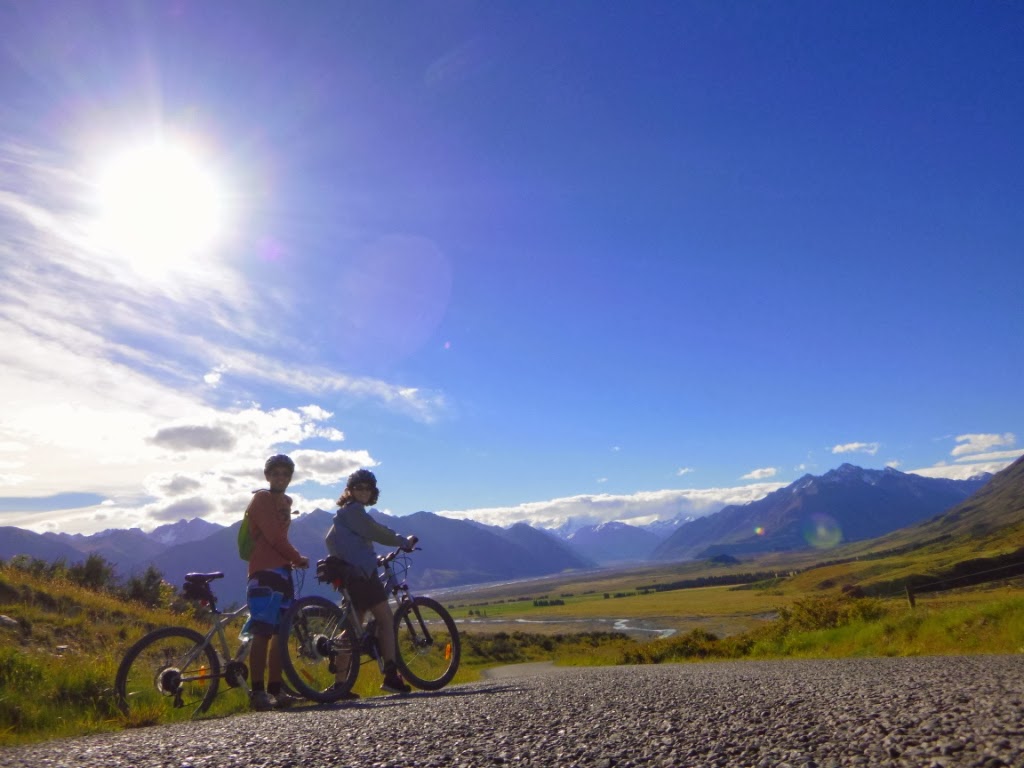
También hemos dado paseos en bicicleta, que pudimos aparcar donde nos dio la gana sin candarla ni nada porque sabíamos que no iba a pasar nadie que la pueda o quiera robar.


Lo que sí que nos encontramos es a mis archienemigas las vacas. Desde que soy pequeño que conspiran entre ellas para intentar intimidarme, con éxito, todo sea dicho.


Afortunadamente no estoy solo, tengo a Marina a mi lado, que es más lenta que yo por lo que en caso de ataque vacuno a ella la pillarán antes dándome tiempo a escapar.


Uno de los paseos que más nos ha gustado ha sido el del lago Clearwater. Salimos de Mt. Potts con el viento a favor ayudándonos ya que todo el camino hasta el lago es cuesta arriba.


Una vez llegamos ahí alguien abrió la puerta del valle y se desató un huracán, o similar. Tal era la fuerza del viento que tardamos el doble en volver que en ir, y eso que la vuelta era bajada. Increíble, teníamos que pedalear o nos parábamos.

Mosquitos y sandflies

Hace muchos años Mosquito y Sandfly se reunieron entre unos arbustos próximos a un lago con tal de conspirar contra los humanos. Debatieron durante mucho tiempo la mejor manera de enfrentarse a ellos y no llegaron a ningún acuerdo.

Sandfly proponía ir a lo bruto a plena luz del día como señoras el primer día de las Rebajas. Mosquito no estaba de acuerdo porque a plena luz del día sería muy fácil que el Hombre les viera y matase. Él decía que era mejor ir por la noche, cuando las personas tienen dificultades para ver.

A la mañana siguiente Sandfly partió, junto a un trillón de hermanas, a la caza del Humano. Cuando el Sol empezó a ponerse Mosquito vio llegar a Sandfly, sóla. El resto de sus hermanas habían muerto aplastadas por el Hombre.

Mosquito, después de decirle el “ya te lo avisé” de rigor, partió junto a sus hermanos en busca del Humano. El Hombre los oyó acercarse, pero al no poder verlos, no pudo matarlos y mosquito ganó la batalla.

A su vuelta Mosquito le explicó su aventura a Sandfly, que decidió que seguiría intentándolo a plena luz del día porque tiene un montón de hermanas sedientas de sangre capaces de atacar a lo loco sin miedo a las bajas.

Es por esto que actualmente el Hombre lucha durante el día contra Sandflies y se recluye durante las noches porque no puede ganar a los Mosquitos.


Enrique & Marina


After a week, we moved from the stunning landscape and the chilly weather of Arthur´s Pass National Park to Bill and Marion´s place in Greta Valley, where we spent Christmas last year. Firstly, we had been invited to spend the Summer Holidays with them, but we´ll be busy during these dates in Glenorchy, so we had Christmas dinner a bit earlier.


This year the weather was nicer than in 2012 and we could spent as much time in swimming costume and flip flops as we liked in December, which coming from the North Hemisphere is quite unusual. It wasn´t as hot as it gets in Australia, nothing like the past summer at Lauriston where we had a basic backpack ready to leave ASAP in case of a bushfire. Anyway, it was really nice and sunny although I had my (classic) hay fever episode, of course, even while taking pills.


In Greta Valley, we helped Bill and Marion with the re-vegetation with native plants of their gully. They grow the natives form seeds the collect from friends, family or even from the bush. The plants have to grow first in pots and then, when they´re strong enough, they can be re-potted on the ground. The trouble comes when your gully had been taken over by grass and weeds. Then, even though you plant natives, the grass will come back so it´s very important to keep the grass low to avoid it blocking the sun and sucking all the water and nutrients from the soil. The gully was a blackberry and grass jungle when Bill bought it, they´ve done a great effort and it´s looking better and better every time we see it. A part from working in the gully and, as you can see in the picture, we looked after Fern a couple of days while they we away. She´s now eighteen months and is full of energy that needs to be used!


It was impossible to have a nap if Fern was around. While we were working in the farm she also stayed with us and helped in her particular way: if we were picking raspberries, she would ate them directly from the bush; if we were weeding, she would use her mouth to pull any plants near her; while we were feeding the chickens, Fern chased them… and when she was getting tired, just laid on the shade to make us feel jealous.

And before I forget, Marion keeps bees and makes her own honey. One of these days, we were gardening around the gooseberry bush in front of the bee hives and something (Fern?) bothered them. Unfortunately, they missed the actual intruder and a couple of soldier bees stung Enrique in his head. In his head!!! It hurt a lot, but he didn’t cry and, as he’s not allergic, we didn’t have to rush. The poor bees died, though.

Kaikoura

Kaikoura is the place where Enrique swam with dolphins last year. It’s a beautiful peninsula a few kilometers north from Greta Valley and Enrique didn’t explore it when he was there the past summer. For this reason, we decided to go and have a look around like normal tourists do.


In the picture above you can see how the Kaikoura Range (2000m high and over) ends in the ocean, just next to the Kaikoura Canyon which is 3000 m deep under the sea level. But the picture is not about the landscape is about how straight Enrique has his back. His mother, like any other in the world, taught him to walk with his back straight, shoulders back, drink the juice before its loses its vitamins, take a jacket at night because it’s chilly and this sort of things.


Now this picture is about the landscape, I am somewhere in the middle, though. During our way we saw seals, a huge colony of some sort of seagulls and lots of tourists, but still no whales. Next time maybe.

In the planes of Rohan

Rohan is the horse riders country of the Lord of the Rings and its capital city is Edoras. And this is where we are at the moment. In real life, we’re in Mt. Potts Lodge and Station where Peter Jackson decided to shot the scenes happening in Edoras which is actually called Mt. Sunday. It’s the little hill I’ve got at the back of my head in the picture and it’s called like this because in the old days all the farmers of the area used to meet there to have a chat and a picnic on every Sunday.


This is the Highcountry of New Zealand, and it’s like a different world.


Highcountry stands for the group of Alpine valleys in central South Island of NZ which can only be reached by helicopter or using very long gravel roads that get rougher and rougher as you drive further.


There, there’re only huge cattle stations, more than 1000 Ha the smallest one. There’re no towns, there is no mobile phone signal, there is no seal on the roads.


So far, we’d always found some sort of analogy between the landscapes of NZ we’d visited and somewhere in Spain (with huge differences, of course). Abel Tasman with the Balearic Islands; Arthur’s Pass with the Pyrenees; the Highcountry with… nothing. It’s simply impossible to compare with anything we’ve seen before.


It’s enormously huge. We’re in the middle of glacial valleys whose walls are mountains higher than 3000 m. Days are usually bright and clear and, literally, we can’t see further: our eyes can’t reach the end of the view, but there’s more at the back. Besides, there’s no pollution to blurry the horizon so it’s seriously impressive. I’ve never seen such a clean air before.


There’re crystal-clear creeks and rivers everywhere coming from the melting snow remaining at the mountain tops and salmons and trouts (like the one we’ve eaten tonight) swimming peacefully.


The paddocks are so big that sheep, cows and deer look like they’re just freely wandering around the mountain. The grass they eat must be really nourishing as well, or at least that’s the impression we get when we see bulls like this Angus in Mt. Potts Station.


But the most captivating fact is that you can walk for hours round all this immensity and not find anyone at all.


You can climb Mt. Sunday to check that you won’t see anyone in the valley; you won’t hear anything but the water of the river, the birds, the sheep or a soprano cow eating hay in her paddock.


Regarding the nights, spectacular. The sun sets just before ten o’clock and these days the moon’s been very big and bright. Enrique’s taken this opportunity to play with his camera settings and take a few pictures at night (this one has an exposition time of sixty seconds).


Furthermore, here we’ve met two 20-years-old-German girls travelling together. They got here a week before us and the weather wasn’t that good so they only could go to Mt. Sunday. 


But this week they’ve been doing some of the walks we’ve found, too. It’s been great meeting them not only because they’re great people but also because they’ve been good company regarding that this time we haven’t been exactly with a family.


We spent most of our free time walking, which is also the main activity you can do at Mt Potts when it’s not winter.


One of our favourites was the Mystery Lake track. The track obviously leads to the Mystery Lake, but we didn’t check it because we didn’t reach the end. So, it’s a mystery for us. That was “the” joke of this update if you haven’t notice.


We also went mountain biking. And we didn’t have to lock the bikes because no one will come and steal them.


What we did find were Enrique’s biggest enemies: cows. Since he was a kid they conspire and try to, successfully, intimidate him


Fortunately he’s not alone with them, I am with him too. Besides, as I am slower than he is cycling, in the event of a beef attack they’ll take me first, giving him time to scape. Or, at least that is what he thinks.


Another good one was the Clearwater walkway which is suitable for mountain bikes as well. We left Mt. Potts with the wind blowing on our favor which was really handy as the road was uphill this way.


Once in the lake, someone opened the wrong door and some sort of hurricane escaped from there. The wind was so strong that coming back took us longer although it was downhill. Unbelievable: when we stopped pedaling the bike immediately stopped too.

Mosquitoes and sandflies

Long time ago, Mosquito and Sandfly met under a bush next to a lake to make a plan against Men. They discussed for a long time which would be the best way to fight them but they didn’t reach any agreement.

Sandfly proposed a massive daylight attack in the same way as housewives would go into the mall on the first day of summer sales. Mosquito wasn’t happy with this because during the day people could easily see them and kill them. He proposed to do it at night, when people have difficulties to see.

Next morning, Sandfly left to the catch of humans with a trillion of siblings. Then, when the Sun was setting, Mosquito saw Sandfly coming back alone. The rest of her siblings died squashed by humans

Mosquito, after saying the compulsory: ”I told you” , also left with his siblings to look for Men. Men heard them getting close, but he couldn’t see Mosquito and his brothers so he couldn’t kill them and Mosquito won this battle.

Mosquito got back and told his adventure to Sandfly, but this last one didn’t change his mind about attacking on daylight: Sandfly had lots of siblings very thirsty of blood with no fear at all of dying.

From then on, Men fights Sandflies during the day and looks for shelter at night because he can’t beat Mosquitoes.

Enrique & Marina