domingo, 17 de noviembre de 2013

ABEL TASMAN NATIONAL PARK


Click here to read the English version

La principal atracción de la región de Nelson es el parque nacional de Abel Tasman. En folletos y guías de viaje dicen que es el parque nacional más bonito de Nueva Zelanda y que no visitarlo es pecado mortal.


La verdad es que esta es la única esquinita de todo el país donde uno se puede encontrar playas y calas recónditas de arena dorada donde poder bañarse tranquilamente pero claro, si vienes de España, lo de las playas de arena dorada te da un poco igual, a menos que seas de los Monegros, claro.


Nosotros estuvimos un día entero de excursión por el sendero costero (Abel Tasman Coastal Track, más de 50 km) y hay que decir que es bonito, como Menorca (incluidos los alemanes).


Por cierto, una pequeña nota histórica sobre el señor que da nombre al parque nacional que he leído en la “Penguin History of New Zealand” (es un ladrillo de 600 páginas, no os penséis que es un libro con dibujitos por llevar a un pingüino en el título).

Abel Tasman era un navegante de origen holandés al que la Compañía Holandesa de las Indias Orientales envió a navegar por los mares del sur en busca de la Terra Australis entre los años 1642 y 1644.

Según la teoría de la época, para que en el planeta hubiese equilibrio debía existir una gran masa de tierra en el océano Pacífico y debían comprobar si esa masa era Australia (en aquella época sólo habían descubierto parte de la costa oeste, la que bautizaron como Nueva Holanda) y buscar ahí oro como posesos.

Este señor, Abel Tasman, tiene el mérito de haber “descubierto” la isla de Tasmania, Nueva Zelanda y Fiji… sin encontrar Australia (al menos en su primer intento). Como anécdota para cogerle simpatía a este tulipán simplemente deciros que ancló su barco en Golden Bay (a dos horas de donde estamos nosotros). Los maorís lo vieron desde la costa e hicieron sonar sus caracolas (o cuernos o lo que fuera) declarándole al guerra (era el primer barco europeo que llegaba por la zona) pero Tasman pensó que lo que le daban era la bienvenida, a lo que contestó haciendo sonar sus trompetas. Los maorís lo interpretaron como un acuerdo de ir a matarse los unos a los otros. Así que mientras la tripulación de Tasman fue al encuentro de los maorís con quesos Gouda y tulipanes, los otros fueron con lanzas y hachas. Total, Tasman y sus marinos acabaron huyendo y redactando un informe diciendo que en estas tierras no había nada de lo que habían venido a buscar. Ironías de la vida esa zona se llama Golden Bay porque está llena de oro, que es precisamente lo que el señor Tasman debía encontrar.

Volviendo al meollo de la actualización, es una lástima que el gobierno base toda la publicidad del parque nacional en su vertiente costera ya que lo que verdaderamente nos ha encantado ha sido el interior del parque.


Nos fuimos de picnic al bosque de Takaka donde fuimos de excursión hasta el Hardwoods Hole, la sima más profunda de Nueva Zelanda (357 m) con una caída vertical inicial de 183 metros.


La montaña de Takaka es básicamente un gran bloque de mármol sobre el que crece un bosque de estos de árboles muy altos, juntos pero sin agobiar, llenos de líquenes muy de película fantástica.


De hecho Peter Jackson pensó lo mismo que nosotros y lo escogió como una de las localizaciones de la primera película de El Señor de los Anillos. Es el bosque por el que los hobbits huyen de los malos antes de llegar a Bree (esto es bastante al principio y en la película es de noche).


Una vez visto el Harwoods Hole, arriesgando nuestras vidas según el DOC (Departamento de Conservación de Nueva Zelanda) porque no está vallado, nos fuimos a la cima de la colina, donde hay un afloramiento de mármol con buenas vistas.


Y ya de vuelta, por fin, vimos a uno de los famosos caracoles carnívoros de Nueva Zelanda avanzando raudo y veloz a través de la hojarasca. Si parpadeamos, nos lo perdemos.


Para acabar os dejamos una foto de la cala en la que hicimos otro picnic con Steve y Judy, a la que hubo que llegar prácticamente haciendo escalada horizontal, pero mereció la pena.


La canoa de Aoraki

El dios Aoraki y sus tres hermanos eran hijos de Ranginui (el Padre Cielo) y su primera mujer, Poharua Te Po, por lo que eran hermanastros de los setenta y cuatro dioses hijos del Padre Cielo y la Madre Tierra (mito de la actualización anterior).

Aburridos de estar en el cielo sin nada interesante que hacer decidieron bajar a la Tierra a conocer a sus medio hermanos. Liderados por Aoraki navegaban en su canoa por el océano del sur cuando Tawhirimatea, el dios de las Tormentas, envió una devastadora tempestad que hizo volcar la embarcación.

Aoraki, sus hermanos y el resto de la tripulación se encaramaron a la canoa volcada para evitar ahogarse. La fuerza de la tormenta fue tal que convirtió la canoa y a sus ocupantes en piedra.

De este modo la canoa de Aoraki, Te Waka a Aoraki, se convirtió en la Isla Sur de Nueva Zelanda, y la tripulación en los Alpes, siendo Aoraki el pico más alto (Aoraki - Mount Cook) y sus hermanos los picos más cercanos.

Por ahora lo dejamos aquí, en breves os presentaremos a nuestro nuevo compañero de viaje.

Enrique & Marina


English version


Then main tourist attraction of the Nelson region is the Abel Tasman National Park; a part form the wineries, but we’re not into wine at all. The leaflets say it’s the most beautiful natural park in New Zealand and not going is mortal sin.


Well, it’s actually the only spot we’ve been in New Zealand where the beaches are long and sandy, there’re tiny bays with golden sand where you can swim or camp and the weather is good enough most of the time. But, sorry, coming from the Mediterranean Coast, we’re not very impressed with beaches.


We spent a day walking part of the Abel Tasman Coastal track which is 50 km long although we didn’t walk that much. In our opinion, it’s really beautiful and reminds us to Menorca (including the German tourists).


And by the way, let me tell you a little history note about the explorer who gives the name to the Park that I read in the “Penguin History of New Zealand” (a 600 pages brick, don’t think it’s a little children’s book with lots of drawings, Penguin is the publishing company).

Abel Tasman was a sailor from Holland hired by the Dutch company of United East India and was sent sailing to look for Terra Australis between the years 1642 and 1644.

In those days, they had the theory that it “had” to exist a huge mass of land in the Pacific Ocean for the planet to be balanced. They had already discovered the West Coast of Australia, which was named New Holland at first, but they wanted to check if this was that huge mass of land and start looking for gold like mad men.

Mr. Abel Tasman has the honor of “discovering” the island of Tasmania, New Zealand and Fiji… but not Australia (at least on his first attempt). But there’re more funny stories about this Dutch. When he reached Golden Bay (about two hours far from here) and anchored his boat there, they were the first European boat getting to this area. The Maori people settled in the coast saw them and blew their horn (or whatever they used at this time) as a war declaration signal. But Tasman though they were welcoming them, so he made his horns blow as well. Then, the Maori understood it as an agreement to start killing each other. Thus, while the Dutch crew went to meet the Maori with Gouda and tulips, the others carried lances and axes. So, Tasman and his men ran away and wrote a report which said that there wasn’t anything they were looking for in this land. Ironically, this area is called Golden Bay because it was full of gold, which is what Tasman was after.

But, getting back to the sightseeing, it’s a bit of a shame that all the attention and the marketing goes basically to the coastal part of the Abel Tasman National Park because the inland part it’s even more unique (from our point of view, as always).


We went for a picnic to the Takaka forest and for an excursion to the Hardwoods Hole, the deepest of New Zealand (357 m) with a vertical fall of 183 m.


The Takaka hill is basically a huge marble block and a forest growing at the top, with lots of tall threes covered in black fungus giving to the whole place a fantasy film look.


In fact, Peter Jackson had the same feeling as we did and chose the location as one of the sceneries for the first episode of The Lord of the Rings. It’s the forest where the hobbits have to run away from the bad ones before getting to Bree (this is pretty much at the beginning of the film and it’s nighttime in the movie).


After checking the Harwoods Hole, risking our lives according to the DOC because it’s not surrounded with a fence, we climbed to the top of the hill where there’s an interesting marble outcrop and very good views of the valley.


And on our way back, at last, we saw one of the famous carnivorous snails of New Zealand moving fast through the foliage. If you blink, it’s gone.


Finally, here is a picture of another picnic we had in a bay of Kaiteriteri with Steve and Judy. The way was a bit challenging because was basically horizontal rock climbing. But there was no one there but seagulls, was a very nice and peaceful bay so completely worth the effort.


Aoraki’s canoe

The God Aoraki and his three brothers were Ranginui’s (Father Sky) and his first wife’s (Poharua Te Po) sons, so they were step brothers of the seventy four Gods that Father Sky had with Mother Earth.

Bored of living in the Sky with nothing interesting to do, they decided to descend down to the Earth to meet their half-brothers. Led by Aoraki the four of them sailed the Southern Ocean in his canoe. Then Tawhirimatea, the God of Thunderstorms, sent a devastating gale which turned over the boat.   

Aoraki, his brothers and the rest of the crew climb to the top of the up-side-down canoe to avoid drowning. But the storm was so strong that turned the ship and his passengers to stone.

This is the way how Aoraki’s canoe, Te Waka a Aoraki, became the South Island of Aotearoa (New Zealand) and the crew became the Alps, being Aoraki the highest peak (Aoraki-Mount Cook) and his brothers the nearby peaks.

Enrique & Marina

viernes, 15 de noviembre de 2013

ALBAÑILES, CAFETEROS Y PINCHES


Click here to read the English version

Durante nuestro tiempo en la región de Nelson hemos ido de excursión al parque natural Abel Tasman, Judy y Steve nos han llevado de barbacoas y picnics a las playas de la zona y hemos ido a ver un bosque de cuento de hadas (escenario del Señor de los Anillos) que conduce a un agujero de 370 m de profundidad en una montaña de mármol. Pero no nos adelantemos a los acontecimientos, de todo esto hablaremos en la próxima actualización.

Hacer café y picar zanahorias

La temporada de verano se acerca a Nueva Zelanda por lo que en un mes habrá trabajo disponible en la industria del turismo. Marina y yo hicimos nuestros deberes hace algunos meses ya, por lo que podemos adelantar que de diciembre a marzo vamos a estar trabajando (gracias al visado Working Holiday) en un lugar que quita el hipo, pero ya lo contaremos mejor en su momento.

Aprovechando nuestra estancia en Jester House Cafe, Steve y Judy nos han estado enseñando habilidades que nos serán de utilidad. Steve ha acogido a Marina como aprendiz en la cocina y Judy me ha acogido a mí como aprendiz de camarero.


Steve, que se sacó los estudios de chef en las fuerzas aéreas del ejército neozelandés, está enseñando a Marina a manejar un cuchillo para que pique zanahorias y demás cosas picables o cortables a un nivel de calidad de cocina de lujo (lo que le será de utilidad en un mes) y otros trucos muy útiles para una pinche de cocina. De Cat y el otro Steve, los otros dos chefs, Marina está aprendiendo otros trucos, sobre todo de pastelería. A cambio de todo esto se ha convertido en la lavaplatos más rápida de la región.


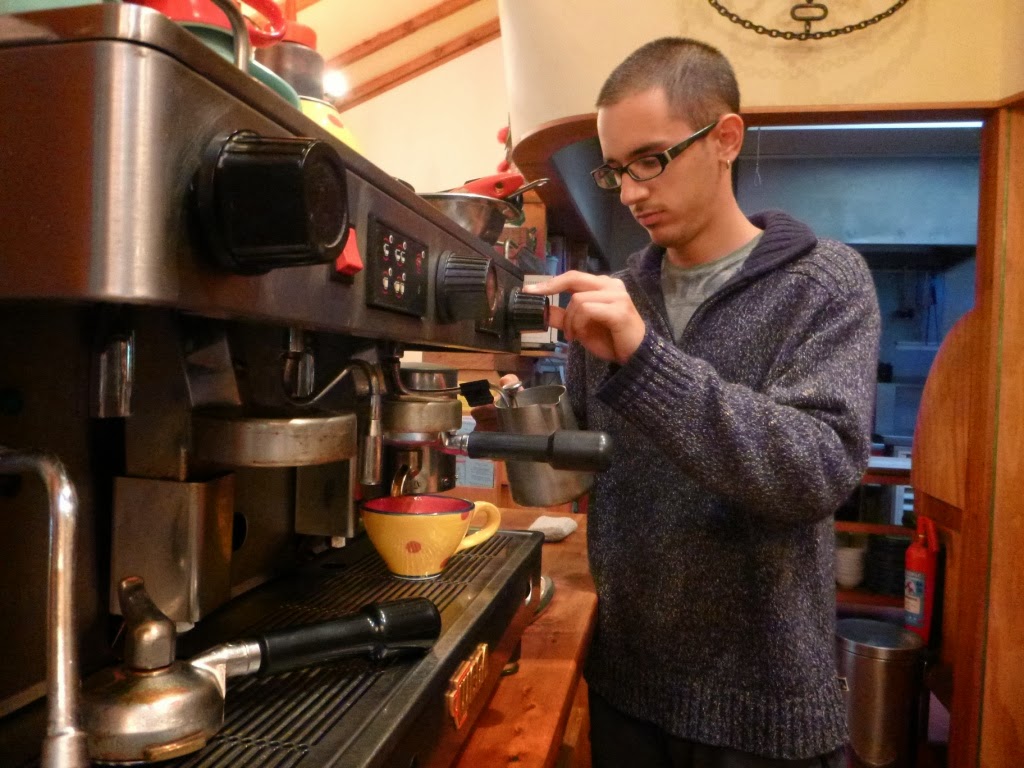
En cuanto a mí, además de aprender a llevar dos platos en una mano y reconocer un Sauvignon de un Chardonay por la tonalidad de blanco gracias a Judy, estoy aprendiendo a hacer café, que es toda una ciencia.


Steve me explicó toda la teoría acerca del tueste de los granos de café, la mejor forma de triturarlos y cuándo hacerlo, la temperatura adecuada del agua, cómo mantener la máquina de expresos en perfecto orden de revista… y cómo calentar la leche, que es lo más difícil y lo que distingue un café bueno de una mierda. Por cierto, una cosa interesante, al calentar la leche con el surtidor de vapor no se hace nada de ruido si se hace bien así que si vais a un bar en España y el camarero os deja sordos al calentar la leche le podéis dar un par de collejas de mi parte.

Gracias a la teoría de Steve y a los consejos y trucos de Judy,  experta cafetera a pesar de no beber café, cada vez tengo más maña con el asunto de la leche: calentarla hasta entre 65 y 70 grados de tal forma que se consigan tres fases simultáneas y diferenciadas (líquido, crema y espuma) con las que, combinándolas con el expreso de diferentes formas, se consiguen los siete tipos básicos de café que conforman el menú cafetero de Nueva Zelanda (hace algunos años que está muy de moda el café por aquí por lo que están todos muy puestos).

La importancia del marketing

Hace veintidós años que Steve y Judy empezaron el negocio de Jester House Café. Actualmente son uno de los restaurantes más famosos de la región de Nelson y se encuentran en la final del premio a la mejor cafetería de Nueva Zelanda, que se decidirá en un par de semanas.


Hablando con Judy, CEO de la empresa (CEO son las siglas de Chief Executive Officer, lo que hasta hace poco tiempo se conocía como “el jefe”) una de las cosas que nos ha quedado más clara es la importancia de un buen marketing para que el negocio vaya bien.


Entre muchas otras cosas, Jester House Cafe tiene un club infantil (como el Súper 3) con el que montan actividades una vez al mes. Nosotros hemos coincidido con un día de “kids club” en el que la actividad era fabricar cometas. Steve se encargó de las cometas grandes y Marina de las pequeñas; yo me limité a hacer fotos y cortar celo, nada de riesgo para mí


Los niños se lo pasaron genial y los padres, abuelos y demás parientes tomaron café y pasteles lo que significa dinero para la empresa en el momento (objetivo 1). En cuanto al largo plazo con este club se pretende generar en los niños una afiliación sentimental con Jester House para que, cuando sean mayores, vengan a comer con la familia, lo que significará también dinero para la empresa en un futuro (objetivo 2).

Chestnut Lodge

En la falda de la colina de la propiedad Steve y Judy están construyendo una casita que será energéticamente autosuficiente. La han construido con la misma técnica con la que hicieron el edificio de su casa y de la cafetería, que en inglés se llama “light earth” y es básicamente paja endurecida con arcilla y agua situada entre una estructura de madera y sellada con adobe.

Pues del adobe nos encargamos nosotros. Aquí hemos podido aplicar lo que aprendimos con los Bakes en nuestros siete meses en Kyneton. Ahora bien, aquí el adobe es diferente y, lo más importante, se hace diferente.


Mientras en casa de Rob mezclábamos cal, suelo y agua con una mezcladora mecánica, aquí mezclamos cal, suelo arcilloso, arena, caca de las vacas del vecino y agua… con los pies en el remolque del quad. Sí, caca de vaca.

Al principio teníamos nuestros reparos porque la inclinación natural de una persona cuerda es la de no pisar caca y, claro, ahora teníamos que hacerlo descalzos y con ganas. Al final lo de la caca no es ningún drama. Lo que es algo más pesado es el tema de la temperatura del agua, que está muy fría, y que la cal es corrosiva, por lo que hemos mudado la piel de los pies un par de veces ya. Nada doloroso, no os asustéis.


Resulta que el comportamiento de la arcilla en la mezcla ha sido algo más exagerado de lo esperado inicialmente, por lo que todo el adobe que pusimos y alisamos con mimo en las paredes interiores y exteriores se agrietó de mala manera. Es lo que tiene la arcilla cuando se deshidrata.

Steve ya tenía pensado enyesar las paredes del interior de la casa y pensaba hacer lo mismo con las de fuera. Marina pidió permiso para hacer una prueba con una técnica parecida a la que utilizan los Bakes para suavizar y sellar las estructuras que construyen. La técnica consiste en añadir mucha agua al mismo barro que se está utilizando de tal manera que la mezcla tenga consistencia de leche con nesquik. Una vez conseguido se coge un trapo o esponja y se empapa con la mezcla.


Con ese trapo se frotan las paredes de tal manera que se “disuelve” la capa de adobe más externa consiguiendo que las grietas se rellenen, dando al mismo tiempo un acabado uniforme y áspero muy bonito. Y en eso estamos ahora. En la foto superior se puede ver la diferencia antes y después del trapo.

Biodinamismo

Antes de ir con el mito maorí vamos a ir con el biodinamismo. Hay toda una filosofía astral detrás de esto que no conocemos, pero la cuestión es que preparamos la solución 500 para el jardín.

En concreto lo que tuvimos que hacer fue calentar agua de lluvia (prohibido agua subterránea o tratada con productos químicos) en un recipiente de cobre con madera quemándose (no se puede usar gas o electricidad). Una vez el agua estaba caliente la mezclamos con agua a temperatura ambiente para conseguir que estuviese toda a la temperatura corporal.


Se llena un cuerno de vaca con caca de una vaca lactante y se entierra durante un año. Pasado este tiempo se vierte el contenido del cuerno en el agua, que es lo que hicimos. Una vez hecho esto hay que remover la mezcla durante exactamente una hora: hay que remover en un sentido hasta conseguir un vórtice y entonces cambiar el sentido para generar caos. Así continuamente. De este modo se canaliza la energía cósmica.

Una vez hecho todo esto se pone el agua en un cubo, se coge un cepillo y se procede a “bautizar” todo el jardín. Esto no se puede hacer cuando uno quiera, hay que tener en cuenta los ciclos lunares, en concreto para la solución 500 hay que esperar a que la luna esté en un ciclo descendente (nada que ver con creciente o menguante).


Esoterismos aparte el jardín está muy bonito pero claro, si alguien se toma todas estas molestias para echarle cuatro gotas de agua agitada con caca de vaca lactante al jardín, se supone que también se toma otras molestias más tradicionales para cuidarlo, por lo que impepinablemente estará bonito.

El Big Bang

Antes del inicio de los tiempos (esto sería t<0) Ranginui y Papatuanuku se casaron. Tuvieron setenta y cuatro hijos que estaban atrapados entre sus cuerpos, en un estado de infinita nada debido a que lo que unía a Ranginui y Papatuanuku era su amor inmortal, lo que les impedía separarse, literalmente.

Entre los setenta y cuatro hermanos hubo una especie de Guerra Civil entre los que querían forzar la separación de sus padres y los que no. Finalmente, liderados por Tane, consiguieron separar sus cuerpos. La energía fruto de esta violenta separación es la que dio origen al universo: tierra, cielo, estaciones y ciclo diurno.

Papatuanuku se convirtió en la Madre Tierra y Ranginui en el Padre Cielo, ahora separados para toda la eternidad. Las lágrimas de Ranginui caen sobre su amada Tierra en forma de lluvia, mientras que las de Papatuanuku se alzan hacia el Cielo como bruma.

En cuanto a los hijos del Padre Cielo y la Madre Tierra, ahora son los Dioses del Universo. Tawhirimatea se quedó en el cielo con su padre, convirtiéndose en su aliado como Dios de las Tormentas. Tane y el resto de sus hermanos se quedaron con su madre, glorificándola esculpiendo en su cuerpo las maravillas del mundo y creando a los hombres. Ruamoko, atrapado en el cuerpo de su madre por ser el único de los hermanos que no quería forzar la separación de sus padres, es el Dios de los Terremotos destinados a destruir el trabajo de los demás dioses.

Y vamos a dejarlo aquí que tenemos que preparar la actualización sobre nuestras excursiones. Los próximos mitos serán acerca de la creación de las islas de Nueva Zelanda.

Enrique & Marina
English version


During our time in the Nelson region we’ve been in Abel Tasman Natural Park, Judy and Steve have taken us to barbeques and picnics in the beach and we’ve walked a track through a fairy forest that takes you to a 370-metres-deep hole. But we’ll talk about this in the next update.

Making coffee and chopping carrots

The summer season is almost here in the Southern Hemisphere so that means there’ll be plenty of jobs available in hospitality. We did our homework early and we can already tell you that we’ll be working from December to March in a certainly unique place, but we’ll give you all the details latter on.

Taking advantage of being at a café, we’ve asked Steve and Judy to teach us some useful skills for our coming jobs. Steve is giving me gold lessons in the kitchen and Judy provides Enrique with a generous weekly allocation of Judy-tips to be a good waiter and barista.


Steve, who was trained as a chef in the NZ air force, is showing me how to use the knife properly so then I can chop carrots and any other “chop-able” things to a high standard (which I might find useful in a month) plus some other secret tricks I won’t tell you. Joking! Besides, Cat and Steve (Yes! There’re two Steves in just one kitchen!) are also happy to let me do some practice when there’s something I can do. Cat is about our age and she’s been cooking since she was just a teenager. She also makes the aioli at Jester House which is probably as good as Enrique’s but less garlicky. Steve is a great chef (he’s been running his own businesses for several years) but what impresses me the most is his baking: bread, scones, biscuits, cakes, tarts and pies to die for. They not only look amazing but they also taste amazing. Just to show you how good he is: recently they started serving the Plumb Plum Pie which has become that popular that he’s currently baking an average of one per day. Also, he gives me lots of good baking recipes so I happily do some dishes for them when the café is busy.


Meanwhile, Enrique is learning to carry two plates in one hand, to distinguish between a Sauvignon and a Chardonay by their tone of white thanks to Judy. And all the baristas, Monnie, Jess and, again, Judy are helping him to learn the mysterious science of coffee making.


Steve gave him a lecture about coffee roasting and grounding, about how the espresso machine works and how to keep it like brand new after millions of coffees… He also told him about the milk, which is the trickiest part and what distinguishes good coffee from dirty water. Did you know that when the baristas heat the milk up with the steam pipe they shouldn’t be noisy? If they are, it’s because they’re not doing it properly so give them a campion on my behalf.

Thanks to Steve’s theory lessons, Judy’s tips and some practice he’s doing, now he manages to make some drinkable coffees: using the espresso machine; heating the milk up to 65-70 degrees so he gets the three different phases in the jug of milk (liquid, cream and froth); combining them to make the seven basic types of drinks available in the New Zealand coffee menu (there’re only about three in Spain!).

The meaning of a good marketing strategy

Steve and Judy established Jester House Café twenty years ago. Nowadays, it’s a successful business, a popular restaurant of the Nelson region and it’s also in the final stage of the New Zealand Café of the Year contest.


But this success hasn’t come by itself. Talking with Judy, who’s also the CEO of the business (commonly known as “the boss”), we’ve realized how important is having a good marketing strategy to achieve good results in your company.


Besides lots of other things, Jester House has its own kids’ club and they organize activities or workshops once a month or so. We were there one of these days and we made kites for the kids! Steve led the table of the big kites for older kids and I showed the younger ones how to make a smaller version of them. Enrique took pictures and cut some sellotape, nothing risky. 


The kids had fun and their parents, grandparents and other relatives who came with them had coffee, tea and cakes, which is good for the business (1st aim). But by creating a club like this, they’re creating an affective link with the kids so they’ll keep a nice memory about the time they spent playing at Jester house and hopefully they’ll come back as adults as well (2nd aim).  

The Chestnut Lodge

On the slope of the hill of the property they’re building a little place which will be self-sufficient. It’s been made using light earth, like the café, which basically consists in making a structure with wood (or any other material) and filling the walls with straw conglomerated with a clay mixture and then sealing them with a mud plaster.

We’ve been plastering the walls of this little house, called the Chestnut Lodge. Thanks to all the practice we did in Kyneton at the Bakes’ that was easier. Nevertheless, here the materials were different so we had to make the mixture in a different way.


We mixed dirt, lime and water in an electric mixer when we were with Rob, while here we put lime, dirt (containing a very big amount of clay), sand, neighbor’s cow poo and water in the trailer and we mix it with our feet. Yes, cow poo. Yes, with our feet.

At first, we hesitated a bit about this system because human’s natural instinct leads to not to step on shit (not only because it’s slippery and it can make you fall down but also because it stinks a bit). So the situation was that not only we should step on poo but also had to do it on bare feet and be keen on it to get the mixture right! At the end, the poo wasn’t any drama. The hardest part was the temperature of the water, which is really low, and in that sense the manure actually helps because it’s soft, smooth and warm and when it touches your feet you find it pleasant. Furthermore, the lime is corrosive so we got our feet skin changed, only the dead cells though. It was a free peeling treatment really, nothing painful at all.


Moreover, the amount of clay in the dirt was a bit higher than we previously expected thus what was supposed to be the top coat cracked excessively and needed to be fixed.

Steve originally wanted to plaster with a gypsum compound the inside part of the walls, so that was fine to cover the cracks in this side. In the outside part I asked to try to fix it just rendering with very liquid mud, sort of in the same way you would smooth a mudbrick wall. The technique is simply adding loads of water to the mud plaster mixture until it looks like drinking chocolate. Then spread the mixture on the wall with an old rag or a sponge.


As you rub the wall with the rag, the top surface of the existing plaster will dissolve so the new coat will get attached and the cracks will get sealed with the slurry you’re adding, giving a rough but even finish. You can see the difference in the picture above.

Biodynamics

And the last topic before the Maori legend is going to be biodynamics. There’s a whole astral philosophy behind it that we have no idea about, but my point is that we prepared something called the 500 solution for the garden and was quite fun.

What we did was heating rain water (you’re not allowed to use ground water and even less to use water coming from a chemical treatment plant) in a wood fired copper (you’re not allowed to use gas or electricity as energy sources either). Once the water was hot enough we mixed it with room temperature water to get it lukewarm.


You need to have a biodynamic milking cow horn full of cow manure buried for a year. After this time you can pour this old manure in your lukewarm water, and that’s what we did. Then, we had to stir the mixture for exactly an hour in this way: stir in one direction until we get a vortex then suddenly change the direction to create chaos and do it again. In this way we were directing the cosmic energy.

After an hour, we put this water in a bucket and Steve threw drops of the liquid to every part of the garden using a brush. Also, you can’t do this process when you feel like it but you should follow the moon cycle. Particularly for the 500 solution, you should wait until the moon is in a descending period.


Esotericism a side, the garden looks great. But if someone can be bothered doing all this, do you think is not going to take care about the old classic duties like fertilizing or weeding? For one reason or the other the garden is going to look amazing, and that’s what matters.

Origin

Before the beginning of the time (that’s t<0 for those into Maths) Ranginui and Papatuanuku got married. They had seventy four children who were trapped between their bodies in a never-ending-nothingness. Nevertheless what kept their parents literally stuck together was their immortal love.

The seventy four brothers had a big argument between the ones who wanted to force their parents to separate and the others who didn’t want to. Finally, led by Tane, they managed to separate Ranginui’s and Papatuanuku’s bodies. The energy coming from the violent separation originated the universe: earth, sky, seasons, day and night.

Papatuanuku became Mother Earth and Ranginui, Father Sky, now a part forever. Ranginui’s tears drop over his beloved Earth as rain while Papatuanuku’s tears reach the Sky in the shape of fog.

Mother Earth’s and Father Sky’s sons are now the Gods of the Universe. Tawhirimatea stayed in the Sky with his father, he became his partner as the God of Thunderstorms. Tane and the rest of the brothers preferred to remain on Earth, glorifying her, carving her body with the shape of the wonders of the world and creating the humanity. Ruamoko was kept trapped in his mother’s body because he was the only one who didn’t accept to force his parent’s breakup. Then, Ruamoko became the God of Earthquakes, whose aim is to destroy his brothers’ work. 

Enrique & Marina